roysworldlogosmall
line
roylogo2012
line2
roysreviews2012
line1

This page contains reviews of films seen during the months of January to March 2012

line1a1

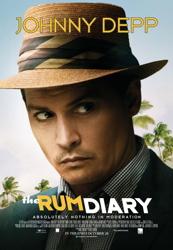
“The Rum Diary”-Based on the novel (semi-autobiographical?) of Hunter S. Thompson, “The Rum Diary” is a drunken mess. Johnny Depp, who seems drawn recently to some pretty less than worthwhile films (think “The Tourist”), stars as Paul Kemp, an alcoholic writer in 1960 who is hired to write an astrology column for a dying San Juan newspaper run by an angry and pathetic editor (Richard Jenkins). Although trying to avoid alcohol and dreaming of writing serious social articles, Kemp finds himself drawn to pitiable characters, including the paper’s friendly photographer, the unshaven Sala (Michael Rispoli), and another writer, Moberg (Giovanni Ribisi), who looks very much like something the cat dragged in. When Kemp finds himself being recruited by a slick and sleezy businessman, Sanderson (Aaron Eckhart), to take part in a legally questionable activity, it’s Eckhart’s beautiful girlfriend, Chenault (Amber Heard) who gives Kemp a reason for living and a little pizzazz to the film. Kemp, however, seems too bright to find himself in the ridiculous situations that occur in the film, including a fire-breathing car chase in the Puerto Rican backwoods. But the worst thing about “The Rum Diary” is that the script is flat, the story (whatever there is of it) is dull, and except for a few scenes along the beach, even the scenery is ugly. D (2/19/12)

rumdiary

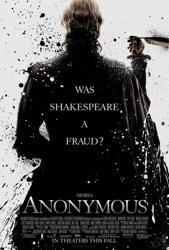
“Anonymous”-This was an unusual choice for director Roland Emmerich, usually known for disaster thrillers such as “2012” and “The Day After Tomorrow.” This time he chose to expend his efforts on a speculation about the true authorship of the plays and poems of William Shakespeare, one known as the Oxfordian theory. “Anonymous” begins with a Broadway introduction by the incredibly articulate Derek Jacobi, exposing Shakespeare’s lack of education and experience and the unlikelihood that he could have authored the plays for which he is known. The scene then morphs back to the 16th century and the Elizabethan era. Edward de Vere, Earl of Oxford (Rhys Ifans), is the hostile son-in-law of Elizabeth’s primary advisor, William Cecil (David Thewlis), a man who for fanatic religious reasons despises all of the creative arts, especially plays and poems. Rhys Ifans provides a stunning and, for him, unusual performance as an articulate, brilliant, but weak earl who chooses to have others take credit for his written works of art. While he selects Ben Jonson (Sebastian Armesto) to be the “author,” Jonson is reluctant. As a result, an actor, Will Shakespeare (Rafe Spall), who is accused by Jonson of being able to read but not write, jumps in and takes credit for the works originally described as those of “Anonymous.” But “Anonymous” is also a political history of the Elizabethan era. With Joely Richardson as the young Elizabeth and her mother, Vanessa Redgrave, as the elder queen, the film explores her desires and affairs, and the evil plotting of William Cecil and his son and heir, Robert Cecil (Edward Hogg), to make certain that James of Scotland becomes James I after Elizabeth’s death. The younger Cecil is portrayed as a malicious soul who convinces the queen that the Earl of Essex (Sam Reid) and the Earl of Southampton (Xavier Samuel), who is said to be her own son with her once lover, Oxford, are committing treason by plotting to take the throne for Essex, and should be executed. The significance of this part of the plot is that in real life Shakespeare dedicated some of his works to Southampton. Although not shown in the film, Southampton was a patron of Shakespeare, but the film would have it that the dedications were actually those of Oxford towards his own son. The political plotting is somewhat confusing in “Anonymous” because of two factors. First, the film jumps back and forth in time between the era of the younger Elizabeth and that of the elder. Second, some of the actors playing the important characters are, frankly, a little too similar in appearance. That said, the film is still rather powerful, especially due to the outstanding performances of the brilliant British cast. In addition to those already mentioned, I should note fine performances by Jamie Campbell Bower as the young Oxford (who has a rather erotic scene with the younger Elizabeth) and Trystan Gravelle as the ill-fated Christopher Marlowe (whose murder is attributed in the film to an unlikely source). “Anonymous” presents the Oxfordian theory well. It should be noted that while Mark Twain made it very clear that he did not believe that Shakespeare actually wrote the works attributed to him, presenting a strong case for why Shakespeare's authorship was almost impossible to believe, it appears that most historians continue to stand by Will Shakespeare as the actual author of his plays and poems. B+ (2/11/12)

anonymous

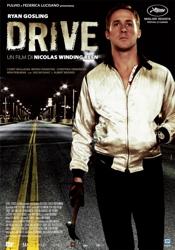
“Drive”-Driver (Ryan Gosling) is a quiet young man who knows how to drive. He drives fast and dangerous as a film stuntman and he drives fast and furious as a getaway man in robberies. And when he has to get away from the police and leave the thieves in the backseat, he has no compunctions about doing so. Then Driver finds himself charmed by a lovely young neighbor, Irene (Carey Mulligan) and her young son, only to discover that Irene’s husband is about to get out of prison. But Driver is an unusual character, not only for his taciturn nature, but also strangely for his human concerns and he volunteers (hoping to help Irene’s husband who is in a predicament with gangsters), to drive the getaway car in what turns out to be the robbery from hell. “Drive” has the virtue of being beautifully photographed and very well paced, and cast with first-rate actors, including Bryan Cranston as Shannon, the owner of the garage where Driver works; Oscar Isaac as Standard, Irene’s husband; Albert Brooks and Ron Perlman as two greedy and malicious gangsters; and Christina Hendricks ("Mad Men") as Blanche, a redhead who makes the mistake of getting involved in the robbery. Ryan Gosling is the actor of the moment, seemingly in every other film and deservedly so. His range is first-rate when one considers the difference between Driver, the pol he plays in “The Ides of March,” and the sad husband in “Blue Valentine.” My only problem with “Drive” is the ending which defies the laws of biology. B+ (2/4/12)

drive

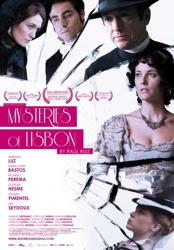
“Mysteries of Lisbon”-A very European 4 1/2 hour movie, “Mysteries of Lisbon,” based on a 19th Century novel by Camilo Castelo Branco, begins with the tale of young João, later revealed to be Pedro de Silva, who lives in an early 19th century Lisbon school run by a priest, Padre Dinis. After João is hit on the head, and recovers, he discovers that he is really Pedro, the son of Ångelina De Lima, the Countess of Santa Barbara, who is extremely unhappily married to the Count of Santa Barbara. And this is just the beginning of a group of tales involving interconnected characters, all centering around Padre Dinis (Adriano Luz) who is also known in the story as Sabrino Cabra, a gypsy, and Sebastião de Melo, a mystery man. The stories are told via the symbolism of a toy stage given to Pedro by his mother. There’s travel, adventure, and mysteries revealed (and some not--who shoots himself at the end of the duel in the second half of the film?), as “Mysteries of Lisbon” takes us on a journey back and forth until we arrive back at the school just after João’s head injury and we reach the ultimate mystery. “Mysteries of Lisbon” moves slowly at times, from stories told to action, but is never dull. Notable in the cast are Ricardo Pereira as Alberto de Magalhães, Maria João Bastos as Ångelina De Lima (who ultimately finds refuge from life in a convent), Clotilde Hesme as Elisa de Montfort and Léa Seydoux (“Midnight in Paris”) as Branca de Montfort. (In Portuguese and French with English subtitles) B+ (2/3/12)

mysteriesoflisbon

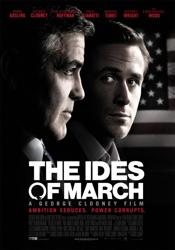
“The Ides of March”-Based on a play called “Farragut North” and directed by George Clooney himself, “The Ides of March” has a wonderful cast which is its strength. Centered around an Ohio primary battle for the Democratic nomination for president, Stephen Meyers (Ryan Gosling) is a young major operative for Governor Mike Morris (Clooney), working under the very experienced Paul Zara (Philip Seymour Hoffman). On the other side is Tom Duffy (Paul Giamatti) who is doing his best to undermine the Morris campaign. For a guy as smart as Meyers seems to be, he much too easily allows himself to be tricked into what appears to be a disloyal act and is close to being exposed by a reporter, Ida Horowicz (Marisa Tomei). There are plenty of political zingers in the script aimed mostly at the right, but the plot turns much too melodramatic when a young intern, Molly Stearns (Evan Rachel Wood), who also just happens to be the daughter of a major political activist, becomes the primary figure in the story. Lasting only a little over 90 minutes, “The Ides of March” is a little too familiar (considering what we see and hear in the news daily), and is wrapped up much too quickly, especially considering the relatively artificial plot twists, to be truly satisfying. The cast includes a brief appearance by Jennifer Ehle, as Morris’ wife, Cindy; and also by one of the most diverse character actors, Jeffrey Wright, as a Senator who uses his powerful endorsement for his own advancement. B- (1/28/12)

idesofmarch

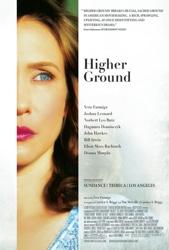
“Higher Ground”-Based on a memoir by Carolyn S. Briggs, “Higher Ground” is Vera Farmiga’s first directorial effort and a fairly good one it is. Farmiga ("Up in the Air") also stars as Corinne, a woman who joins a Christian fundamentalist flock which includes her musician husband, Ethan (Joshua Leonard) and her children, but who seems never completely comfortable with her own search for a connection to Jesus. Exposed to these views by her childhood pastor (Bill Irwin), she continues to follow the preachings of her righteous and all-knowing adult pastor (Norbert Leo Butz) without much thought. But when her best friend, Annika (Dagmara Dominczyk), becomes paralyzed due to a brain tumor, her doubts seem to grow, and some slight feminist concerns occurs, especially when she is told that women are not allowed to preach to men. It seems to me that this kind of film would never have been made in past decades, but is the result of the growing influence of Christian fundamentalists. “Higher Ground” is not political. It’s about a woman’s need for faith and her inability to connect with the obsessive religious views of those around her while never actually rejecting her own religious needs. What makes the film worthy of attention is the cast, which includes several first-rate Broadway players, including Norbert Leo Butz; Donna Murphy as Corinne’s mother; and Nina Arianda as Corinne’s cynical sister. The cast also includes John Hawkes (“Deadwood” and “Winter’s Bone) and an effective performance by Vera Farmiga’s much younger sister, Taissa Farmiga, as the teenage Corinne. With a lesser cast, this film might have been a complete dud because it fails to explain just what is going on in Corinne's mind. B (1/21/12)

higherground

“Contagion”-This is a scary movie, not because the filmmakers wanted you to scream and squirm in your seat like most horror films, but because it is about something that could really happen. “Contagion,” directed by Steven Soderbergh. is the story of the spread of a highly contagious virus that kills quickly and the doctors who try to contain it. We are almost immediately introduced (interestingly, it begins on “Day 2”) to Beth Emhoff (Gwyneth Paltrow) who has been in Asia on business but stops in Chicago to have an affair. By the time she arrives home, she is extremely ill and dies soon thereafter along with her young son. Her husband, Mitch (Matt Damon), discovers quickly that he’s immune, but many others are getting sick and dying. Emhoff and his teenage daughter Jory (Anna-Jacoby Heron) provide the means by which the filmmakers demonstrate how the virus affects daily life in America when fear spreads. We’re also introduced to a slew of doctors at the Center for Disease Control, who are desperately trying to figure out what the virus is, how it spreads, and how it can be stopped without endangering themselves and committing ethical violations. Led by Dr. Ellis Cheever (Laurence Fishburne), the group includes Dr. Leonora Orantes (Marion Cotillard) who heads for Asia; Dr. Erin Mears (Kate Winslet) who attempts to determine the scope of the spread of the virus among victims; Dr. Ally Hextall (Jennifer Ehle) who experiments on herself in hopes of achieving a useful vaccination; and Dr. Ian Sussman (Elliott Gould). One of these doctors will die from the virus. But “Contagion” is also about modern-day hypsters who spread fear and misinformation in order to satisfy their own egos and possibly achieve wealth. This aspect of the story is represented by Alan Krumwiede (Jude Law), a San Francisco Internet blogger who is trusted by his many readers. “Contagion” surprised me. I originally dreaded watching it, but I quickly discovered that the script is methodical and intelligent, while at the same time including many familiar elements of a standard thriller, such as the pulsating and dramatic background music. But what really makes the film worthwhile is the excellent cast. And of these fine actors, I particularly want to note the very appealing Jennifer Ehle as a soft-spoken but courageous scientist. B+ (1/16/12)

contagion

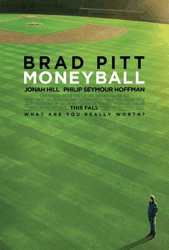
“Moneyball”-It’s not hard to make a list of memorable baseball films. There haven’t been that many. Films like “Bang the Drum Slowly,” “Bull Durham,” “The Natural,” “Field of Dreams,” “Eight Men Out,” and “A League of Their Own” come to mind. “Moneyball,” based on the book by Michael Lewis, can now be added to the list. It tells the mostly true-life story of Billy Beane (Brad Pitt), a ballplayer who apparently had great potential, was signed by the New York Mets for a big bonus in 1980, and who utterly failed to come through as a player (he had 3 homers and 29 rbis over six seasons with the Mets, Twins, Tigers and A’s). But Beane had other baseball talents which emerged when he became a scout for the A’s and ultimately their general manager. As the film begins it is 2002 and the Oakland A’s, who lost to the Yankees in the 2001 playoffs, need to rebuild after losing free agents Johnny Damon, Jason Giambi, and Jason Isringhausen to teams with a lot more money. Beane initially begs the A’s owner for more funds, but then happens upon a young Yale economics graduate, Peter Brand (based on the real-life Paul DePodesta) who has analyzed via computer what makes teams win. Hiring him away from the Cleveland Indians, Beane and Brand (Jonah Hill) begin their job of rebuilding the A’s over the protests of the scouts and other officials who can’t imagine what they’re thinking when they decide to replace first baseman Jason Giambi by signing a ballplayer like Scott Hatteberg (Chris Pratt), a former Red Sox catcher with a bad throwing arm who has never before played first base. Brad Pitt owns this film, turning Billy Beane into a very cool and outwardly self-confident baseball exec who decides to take a chance and go with a whole new approach to creating a major league team. Jonah Hill, who has usually been seen in silly raunchy comedies, does a fine job of portraying Brand, the initially nervous young follower of the sabermetrics of Bill James, who begins to grow in experience on the job. Philip Seymour Hoffman, one of our finest actors, appears in the limited role of the A’s manager, Art Howe, who is very resistant to Beane’s approach and knows his days as A’s manager are numbered. “Moneyball” is a fresh approach to a baseball film, concentrating on the executive office rather than the play on the field, although what happened during the 2002 season becomes an important element of the end of the film. Brad Pitt is memorable as we watch Beane manipulate the team roster and the players to achieve his goals. A- (1/15/12)

moneyball

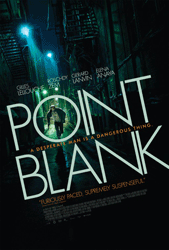
“Point Blank”-The French have a history of excellent gangster films, ranging from classics like “Breathless” and “Rififi” to the more recent documentary-like “Mesrine,” but “Point Blank” more closely resembles a Hollywood thriller than the classic French films of the genre. And, thus, not surprisingly, it’s loaded with the clichés of the American thriller, including the theme of the innocent man and his family caught up in the middle and the corrupt officials who seem to be at the heart of so many of these films (I’ll be circumspect in order to avoid giving away any of the film’s secrets). The film literally begins in the middle of a violent chase, but ultimately flashes back to its origins. Gilles Lellouche is Samuel, a nurse’s aid in a hospital who helps revive an injured thug, Hugo Sartet (Roschdy Zem). Shortly thereafter Samuel is knocked out and his very pregnant wife, Nadia (Elena Anaya), is kidnapped. As a result, Samuel finds himself being forced to commit an illegal act, thus beginning a breathless chase through the streets of Paris. My biggest complaint about “Point Blank” is that the action becomes a little too overwhelming at times. The characters needed to take a few more breaths. But for its genre, it does the job. Maybe because it’s French and not from Hollywood, I found “Point Blank” to be an enjoyable thriller. While the ending wasn’t unexpected and isn’t totally satisfying, the film did contain a few good twists and turns. I particularly want to note the fine job done by Roschdy Zem, a very appealing actor seen previously and memorably in “Days of Glory (Indigènes),” as a safecracker whose true nature and character emerges as the story progresses (In French with English subtitles). B (1/13/12)

pointblank

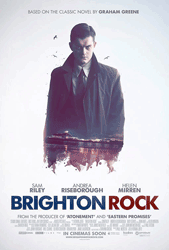
“Brighton Rock”-Based on the 1938 novel by Graham Greene, which was made into a classic film with Richard Attenborough in 1947, this “Brighton Rock” is updated to 1964. After his gang boss is murdered by an opposing gang, Pinkie (Sam Riley) decides to get revenge and bludgeons to death the killer, Hale (Sean Harris), under the Brighton pier. But he quickly learns that a young local woman, Rosie (Andrea Riseborough), was photographed with Hale and Pinkie’s current boss, Spicer (Philip Davis) only moments before. Pinkie must get the photo and woo Rosie in order to get her on his side. Sam Riley (“Control”) is appropriately emotionless as a thug trying to act normal around Rosie, who seems innocent at the start, but doesn’t seem so innocent as things progress. And Pinkie, whose goal is to take over his gang, doesn’t plan on one obstacle, Ida (Helen Mirren), a local woman who liked Hale and doesn’t think much of Pinkie. Updated against a background of youth violence in mid-1960s England, “Brighton Rock” is an effective British gang thriller. Andrea Riseborough is very effective and touching as the young Rosie who goes through a transformation from innocent waitress to gangster’s moll, or at least so she thinks. John Hurt also appears. The film also contains an endearing performance by Nonso Anozie as Dallow, a gangster with a heart. B (1/8/12)

brightonrock

“Tuesday, After Christmas”-I wish I could tell you what the point of this Romanian film was, but it leaves me mystified. It begins with Paul Hanganu (Mimi Branescu) in bed with his mistress, Raluca (Maria Popistasu). It’s quickly obvious that Paul is married to another woman, Adriana (Mirela Oprisor), and has a young daughter (who is getting dental treatment from Raluca). Was it intentional that the filmmakers put glasses on Adriana to lessen her attractiveness? The film proceeds as if we are a fly on the wall of a mundane marital situation. No one seems to notice that Paul looks distracted and expressionless much of the time, and little happens until Paul finally informs Adriana that he is in love with Raluca (incidentally, at this point Adriana takes off her glasses and looks more attractive). Mirela Oprisor has her best scene as she reacts with fury to what her now estranged husband has just told her. Directed by Radu Muntean, who also co-wrote the screenplay, “Tuesday, After Christmas” seems to be all about showing us the fairly common details of the lives of the characters without making moral observations. I can’t say I was bored, but at the end I wondered about the point of the story. (In Romanian with English subtitles). [Note: A.O. Scott of the New York Times listed this film among his best of 2011.] C+ (1/6/12)

tuesdayafterchristmas

“Beginners”-Lovingly directed by Mike Mills, based on a story about his own life, “Beginners” is about life, death, love, sadness, heterosexuality, homosexuality, and a dog. Ewan McGregor is Oliver Fields who tells the story of how his parents were married for over 40 years although his father was gay. The father, Hal Fields, played with great charm and sensitivity by Christopher Plummer, decides at 75 to inform his son that he is gay and that he wants to find out what it’s like to come out. Unfortunately, and although he begins a life with a younger lover, he soon learns that he has terminal cancer. His father has died by the time he tells the story, but Oliver, a somewhat sad young man who has been unable to maintain a serious relationship, meets a lovely young French actress, Anna (Mélanie Laurent of “Inglourious Basterds”), who in many ways is almost as morose as he is, but it’s obvious that they belong together. And in the midst of all this, there is the amazing Arthur (Cosmo), a Jack Russell terrier who was Hal’s pet and has now become a loving, loyal, and somewhat demanding member of Oliver’s household. Mike Mills gets everything he can out of his wonderful cast. Ewan McGregor and Mélanie Laurent are wonderful as a loving couple exploring their emotional needs and weaknesses, and Christopher Plummer turns himself thoroughly into an older gay man. Also of particular note in the cast are Goran Visjnic as Andy, Hal’s young lover, and Mary Page Keller as Oliver’s late mother, Georgia. A touching and moving film. Highly recommended. A- (1/2/12)

beginners
reel2
Return to top
reel
Return to top
reel1reelReturn to topReturn to top